A.D.: New Orleans After the Deluge

Featured by the New York Times, Newsweek, National Public Radio, the New Orleans Times-Picayune, WWL-TV, The News Hour, Salon.com, Rolling Stone, the Wall Street Journal, the Toronto Star, BoingBoing, and many others!

A.D.: New Orleans After the Deluge is a nonfiction graphic novel about a cross-section of seven New Orleans residents and their experiences during and after Hurricane Katrina.

Here is Denise, a sixth-generation New Orleanian who will experience the chaos of the Superdome; the Doctor, whose unscathed French Quarter home becomes a refuge for those not so lucky; Abbas and his friend Mansell, who face the storm from the roof of Abbas’s family-run market; Kwame, a pastor’s son whose young life will remain wildly unsettled well into the future; and Leo, a comic-book fan, and his girlfriend, Michelle, who will lose everything but each other.

Starting with their lives before the storm, the book traces how they deal with the hurricane when it hits, and what happens to them afterward, from losing all their possessions, to facing the flooding, to being trapped in the Convention Center, to evacuating and not being able to return home — all told in comics form. Along the way, A.D. reminds the reader of the vitality and spirit of New Orleans and the Gulf Coast.

A.D. started as a webcomic on SMITH Magazine. Released by Pantheon Graphic Novels in an expanded hardcover edition in 2009, A.D. came out in paperback in August 2010.

A.D. was a New York Times bestseller, was nominated for the Eisner and Harvey Awards, and was selected for inclusion in The Best American Comics 2010, edited by Neil Gaiman. It was a YALSA Great Graphic Novels for Teens selection. In addition, the book was listed on a number of 2009 holiday gift guides, including the New York Times. Vanity Fair magazine declared A.D. to be one of its five “better-than-a-sweater” gift suggestions. And MTV’s “Splash Page” blog called A.D. the best nonfiction comic of 2009.

A.D. has been translated into French and Dutch.

Praise for A.D.

“One of the best-ever examples of comics reportage, and one of the clearest portraits of post-Katrina New Orleans yet published. An essential addition to the ongoing conversation about what Katrina means, and what New Orleans means.”

—Dave Eggers

“The people’s history of Katrina…. A work … of literature, of high art, and of reverence for nature and humanity.”

Los Angeles Times

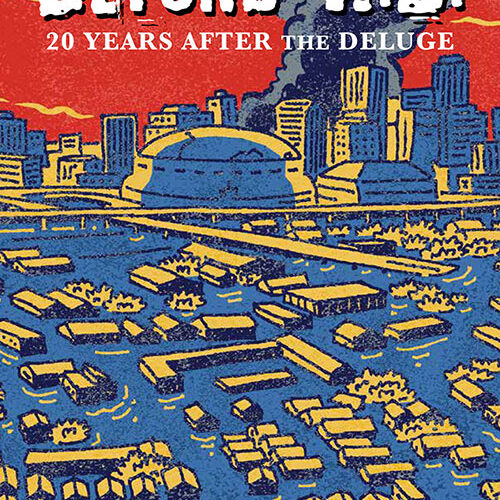
Beyond A.D.

Beyond A.D.

A collection of updates and reflections on A.D.: New Orleans After the Deluge.

Beyond A.D.: 20 Years After the Deluge is a “companion zine” to A.D., bringing together follow-up stories, related comics and illustrations, and previously unseen artwork connected to A.D. 

Contents include: 

  • “A.D. + 10: Katrina Survivors Ten Years Later” (Comics)
  • “3135 Calhoun St. and the A.D. Cosmic Connection” (Text with pictures)
  • “Hamid Mohammadi (May 24, 1959–June 17, 2021)” (Text)
  • “The Persistence of Memory” (Comics)
  • “A.D. (BP): ‘Heck of a Job'” (Comics)
  • And various other illustrations!

From the introduction

I first created A.D. in 2007–2008, profiling a cross-section of New Orleans residents who survived Hurricane Katrina and the subsequent flooding. It was originally serialized online at Smith Magazine, and later expanded into a New York Times-bestselling book from Pantheon.

This year, 2025, marks the 20th anniversary of Katrina—a moment to reflect on the disaster’s legacy and its place in our national memory. To mark the occasion, this “companion zine” brings together follow-up stories, related comics and illustrations, and previously unseen artwork connected to A.D.: New Orleans After the Deluge.

A.D. grew out of my own experiences with the storm. From my home in Brooklyn, I watched in horror as the disaster unfolded on TV. I ended up volunteering with the American Red Cross, was trained as a disaster-response worker, and deployed to Biloxi, Mississippi, just 90 miles from New Orleans. My three weeks as a volunteer informed the creation of A.D.

One of the first widely read works of comics journalism, A.D. became a bestseller, appeared on numerous best-of-the-year lists, and has since been taught in classrooms across the country. It continues to spark conversations about systemic inequality, race, resilience, government accountability, and the comics form itself.

Two decades on, what was once journalism is now history. In today’s era of escalating climate disasters and persistent questions about equity and truth, the themes of A.D. remain urgent. This feels like the moment not just to look back, but to recommit—to remembering, to resisting, to rebuilding. Defend New Orleans!

Seeing Things #1

Seeing Things

Features a foreword by Rob Walker, Josh’s collaborator on Titans of Finance and author of The Art of Noticing (Knopf, 2019).

Josh Neufeld expresses his more whimsical side! The Seeing Things zine pairs a photo of something Josh saw in his everyday life — out on the streets, in the transit system, in his apartment, etc. — with his hand-drawn re-interpretation of the objects. The driving force is pareidolia — those quirky moments when we see faces or creatures in everyday objects: the Virgin Mary on a piece of toast, a cloud that looks just like a cow, a human face on the surface of the moon. Seeing Things reimagines these moments through Neufeld’s cartoonist lens, bringing hand-drawn personality to the inanimate.

From Rob Walker’s foreword:

Like any skilled artist or writer, Josh Neufeld pays attention to the world around him. He is aware of what is there. But he also sees what isn’t there — but possibly could be.  As a maker of comix, he is a skilled artist and writer, and he doesn’t so much “see faces” as recognize and express a certain humanity in the inanimate. Collected, the results are really remarkable, funny, revealing: an exasperated exercise machine, a haughty hand dryer, objects gulping, pointing urgently, asking if you like their hat, or just grunting “ook ook.”

Shared pareidolia is actually a little risky: sometimes I see a face and you just don’t. In Seeing Things, Josh takes those risks in a disarming way that’s inspiring. When you do see the face that Josh sees, the result is a kind of quiet connection. That’s the game, and the more you play along, the more you win.